We pay for music, movies and software because we know what we’re getting. With dating, we’ve somehow accepted paying for the possibility that something might happen.
The subscription that promises everything except a result
Think about the subscriptions on your credit card statement right now.
Netflix gets you thousands of shows. Spotify gets you every song you can think of. ChatGPT helps you write, plan and figure things out. Not every show is a hit and not every answer is perfect, but the moment you pay, you have the thing you paid for.
Now think about dating apps.
Tinder has Plus, Gold and Platinum. Hinge has Hinge+ and HingeX. Bumble has Premium. The features differ, but the pitch is basically the same: pay more, and your odds get better. More visibility. More likes. More control.
It sounds reasonable. But there’s something strange about it.
You can pay for the top tier and still have no one who wants to talk to you.
Seeing who liked you, getting boosted to the top of the stack, sending more likes: these things can help. None of them can make another person actually interested in you.
That’s where my questions started.
Swipe, wait, repeat
I don’t think dating apps are literally casinos, and I don’t think paying for one is gambling. But the experience can feel uncomfortably similar.
You open the app. You swipe. You wait.
Maybe they like you back. Maybe they don’t. Maybe you match and nobody says a word. Maybe you say hi and get left on read. Maybe you talk for three days and then one of you quietly disappears.
So you go back and pull the lever again. The next profile could be the one. The next match could turn into something real.
Anyone who has spent a Sunday night swiping knows that feeling. And the longer I thought about it, the more it seemed to me that the industry had gotten very comfortable selling access to possibilities, instead of making it easier for two people to actually connect.
To be clear: no app can guarantee love. No algorithm can create chemistry. People are far too complicated for that.
But surely we can do better than making two people wait for a mutual swipe before they’re even allowed to say hello.
What if the problem wasn’t that people couldn’t find enough profiles, but that they couldn’t start enough real conversations?
That question became the starting point for Whispa.
The question that changed everything
I started imagining a different kind of app.
One where the first question isn’t just “do you like each other’s photos?” but “might you actually get along?” One that brings people together through their personalities, lifestyles and the things that shape how they connect.
And one where, when two people are especially compatible, we remove the biggest obstacle in online dating: the mutual like.
The idea sounded almost too simple. You find someone who seems genuinely compatible with you. Instead of liking their profile and hoping they eventually notice, you just introduce yourself.
Not by forcing them to reply. Not by pretending you’re both already into each other. Just by giving you the chance to start a conversation, without waiting for an algorithmic coincidence.
They still decide whether to answer. Their choice and their boundaries matter just as much as your chance to reach out. But the first step no longer depends on two people swiping right at the same time.
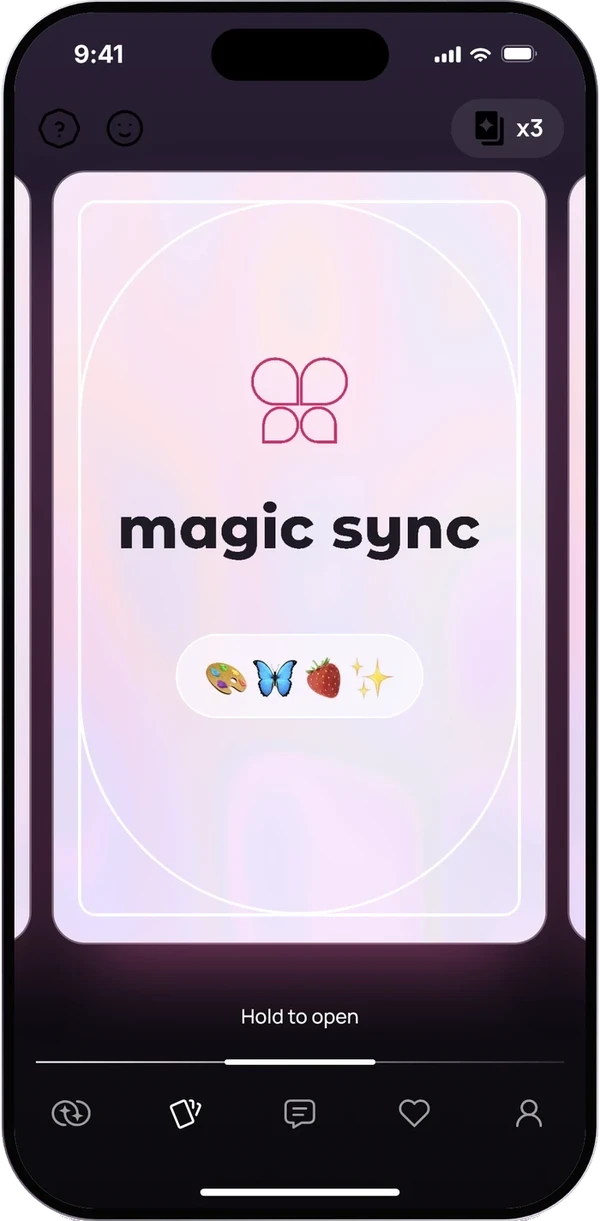
That idea eventually became Magic Sync. And once it was in my head, I couldn’t let it go.
“Okay, but how do you know two people are compatible?”
When I talked about the idea with friends, they all got the frustration. They all liked the idea of skipping the mutual like. And almost every one of them asked the same thing:
“Okay, but how are you going to know two people are compatible?”
Fair question.
My first answer was psychology. A short questionnaire about who you are, how you approach relationships and what you value. Not one of those exhausting tests with hundreds of questions, but something quick and interesting enough that people would actually want to finish it.
Combine that with lifestyle, intentions and a few other signals, and you get a much fuller picture of a person than photos, age, distance and a two-line bio.
Then the people I interviewed brought up something I didn’t expect.
Astrology.
“What’s your sign?” is back, and it means more now
Over time, I had about a hundred conversations about dating, compatibility and what frustrates people about the apps they use. Many of them were with women.
And astrology came up again and again.
Some people wanted to know a guy’s sign before agreeing to a first date. Some had signs they always seemed to fall for. Some had a combination they swore by, or one they now avoid at all costs.
In the ’70s, “What’s your sign?” was a cheesy pickup line at singles bars. Today it’s a real question, and people expect a real answer. According to Pew Research Center, about 3 in 10 American adults consult astrology, tarot or a fortune teller at least once a year. Among women ages 18 to 49, almost half consult astrology at least yearly (Pew Research Center, 2025).
And this isn’t a passing fad. A study of two centuries of books found that interest in astrology has stayed remarkably stable over time (Genovese, 2015). Search data tells a similar story: interest rises and falls, but it never goes away, and it spiked in 2020, the year the world felt most uncertain (Spectrum News). When life feels unpredictable, people look for patterns, and for a little help understanding themselves and each other.
You see it everywhere once you start looking. Friends compare birth charts in group chats. People put their Sun, Moon and rising signs in their bios. Recently I was watching HBO’s I Love LA. In one scene, two friends are stuck in line outside a club, and one of them goes to talk her way past the bouncer. While she’s gone, the other one starts chatting with a guy who turns out to own the place. He’s going to walk them right in. Oh, and he’s a Gemini. So is she. A minute later they’re holding hands and heading inside. Two Geminis, no explanation needed: everyone watching already knows Geminis are the ones who can talk to anyone and make friends in a line outside a club.
Crystals, birth charts and Southern California
In California, and especially in Southern California, it goes even further. By Google search interest, California ranks among the ten most “new age” states in the country (Cultural Currents Institute).
Walk into a crystal shop in Venice, Silver Lake or Ojai and you’ll often find stones grouped by zodiac sign, or staff who will help you pick crystals based on your birth chart. Rose quartz is sold as the stone of love. People buy a piece for their sign the way someone else might buy a candle for their mood. For a lot of Angelenos, a crystal on the nightstand and a birth chart app on the phone are just part of everyday life.
For me, this wasn’t new. I’d been interested in astrology for years, as one more lens for getting to know someone.
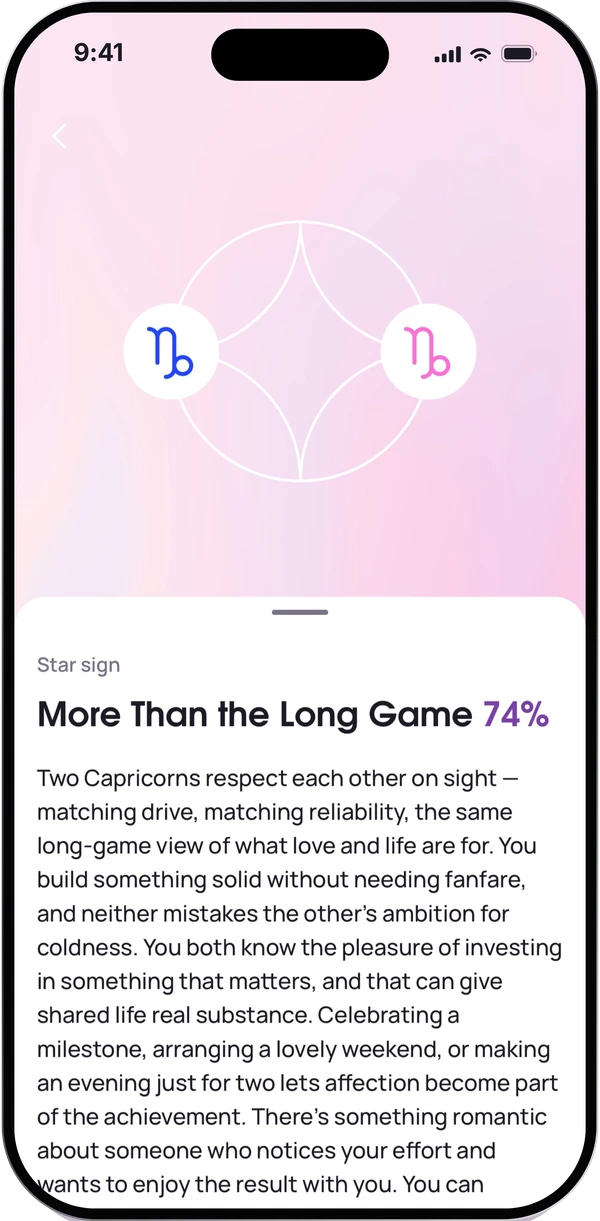
But these conversations made me look at it differently. I had mostly thought about the twelve familiar signs. Then I started learning about natal charts and synastry, the practice of comparing two birth charts to read how two people might interact. Instead of just your Sun sign, astrologers look at where every planet was when you were born, and how your planets connect with someone else’s. (We wrote a plain-English guide to synastry if you’re curious.)
I also started noticing patterns in couples I knew. Libra women dating Sagittarius, Aries or Leo men, for example. Plenty of exceptions, of course.
Four thousand years of looking up
Sure, science hasn’t proven that the stars decide who we fall for. My own observations weren’t research either. But look at how deep astrology runs in human history and culture.
It goes back roughly four thousand years, to astronomers in ancient Babylon who tracked the sky and read meaning into it. Two thousand years ago, Roman emperors kept astrologers close: Tiberius kept the astrologer Thrasyllus at his side for decades, and Augustus put his sign, Capricorn, on Roman coins (University of Michigan). The twelve signs found their way into calendars, art, literature, music and, eventually, the back pages of every American newspaper.
And here’s the part I find most ironic. We live in the age of artificial intelligence, arguably the most advanced technology people have ever built. And I personally know people who ask ChatGPT to build their natal chart. Two millennia after the Roman emperors, we’re still looking up at the same sky, just with better tools.
So I think it’s safe to say this: astrology is a system of symbols, a language and a body of ideas that has survived for thousands of years. You don’t have to believe in it to see what it gives people. It would be strange to ignore it.
Dating isn’t only about measurable variables. It’s also about identity, curiosity, beliefs and the stories we use to understand ourselves. For some people astrology is entertainment. For others it’s a meaningful way to reflect on relationships. For almost everyone, it’s a great conversation starter.
Compatibility is bigger than a zodiac sign
As the idea grew, I realized that neither a personality test nor astrology could tell the whole story on its own.
Picture two people with similar personalities but completely different lives. One wants to spend every weekend on a road trip to Joshua Tree or a last-minute flight to Vegas. The other loves quiet nights, a predictable routine and staying close to home. They might get along great. Or their everyday expectations might be hard to reconcile.
Now picture two people who share hobbies and a lifestyle but handle emotions very differently. One talks things through right away. The other needs space and time. Again, there’s no universal answer.
Compatibility isn’t one magic number hidden somewhere in the universe. It’s a set of dimensions: personality, lifestyle, interests, values, what you’re looking for, how you communicate. And, for the people who care about it, astrology.
I wanted Whispa to bring those dimensions together in a way that’s easy to understand. Not a verdict that two people are destined for each other. Not a promise that it will work out. Just a better way to find people you might otherwise scroll right past.
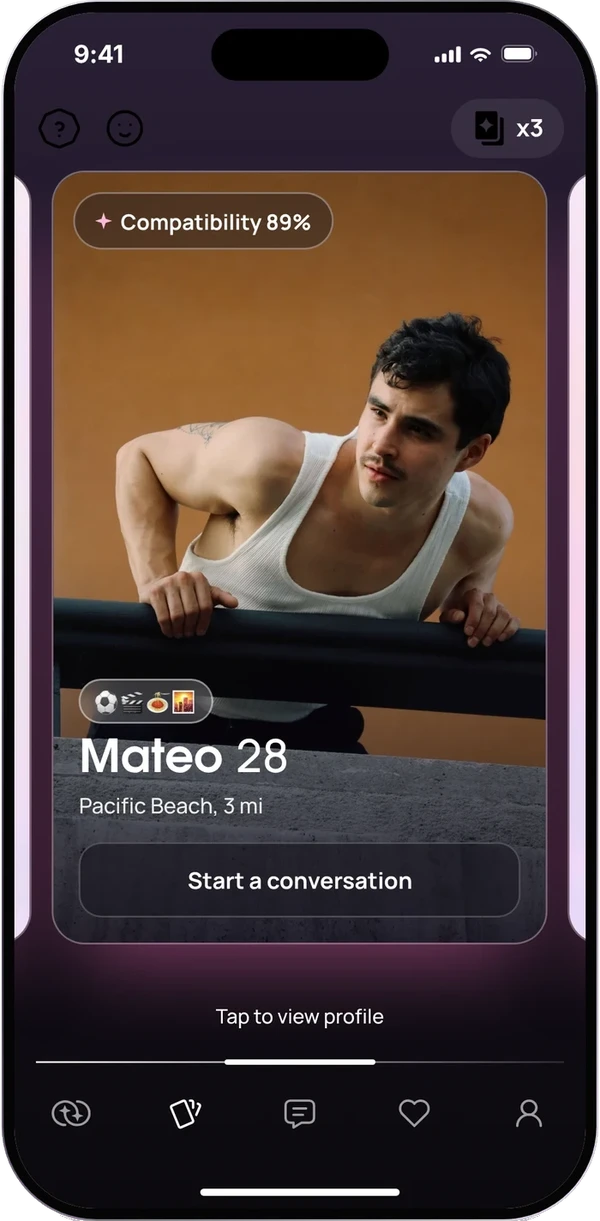
A compatibility score can be a useful starting point, as long as we’re clear about what it means. And the explanation behind the score can be worth even more than the number. Telling two people they’re 89% compatible is one thing. Helping them see why they might click is another.
That became one of the core principles behind Whispa.
From an idea to Magic Sync
The idea is simple. Every day there are more and more profiles, and the people who would truly click get lost in that endless feed. So Whispa looks at several dimensions of compatibility and brings your most compatible people to you, so the right two people don’t scroll right past each other.
And when the compatibility is high, you can write first. No mutual like needed. The other person sees why the app thinks you might click, and decides whether to reply.
It doesn’t mean they’re automatically interested. It doesn’t guarantee a reply, a date or a relationship.
What it does is remove one specific barrier.
It gives you the chance to introduce yourself to someone you may be compatible with, without waiting for a mutual like first.
Think about how we meet people in real life. You don’t walk into a coffee shop, notice someone interesting and wait for a notification confirming they’re into you. You make eye contact. You smile. Maybe you say something. Sometimes it works and sometimes it doesn’t, but the conversation can start before anyone has officially declared interest.
Of course, apps need protections that a coffee shop doesn’t. Unwanted messages and harassment are real problems. That’s why Magic Sync is limited, and why the person on the other side always stays in control. The goal isn’t unlimited messaging. It’s to make a thoughtful introduction possible while respecting the other person’s choice.
I didn’t want to build another Tinder
When I started, I knew competing with the big dating apps would be hard. They have massive user bases, famous brands, huge budgets and years of experience.
Another app with photos, swipes, likes, matches and a subscription wasn’t going to cut it. And honestly, I wasn’t interested in building a slightly different version of something that already exists.
I wanted to question the experience itself.
Why should looks be the gateway to every conversation? Why do two people have to like each other separately before either one can say hello? Why is compatibility treated as an extra feature instead of the starting point? And why do we measure dating products by engagement and subscriptions, when what people actually want is to connect with another person?
Whispa won’t fix everything about online dating. No startup can honestly promise that. But maybe we can improve one moment that matters a lot: the moment when curiosity turns into a conversation.
The hard part: building a community
There’s another uncomfortable truth about dating apps. Even the best product doesn’t work if there aren’t enough of the right people on it.
You can build a beautiful app, a smart compatibility system and new ways to talk. But if someone opens it and sees nobody nearby, it falls apart.
That’s one of our biggest challenges right now. We’re still early. We’ve spent a huge amount of time building, testing and rethinking the product. But building software and building a community are two very different things.
A dating app needs local density: enough people in the same place, looking for similar things, willing to show up. That doesn’t happen just because an app appears in the App Store. You have to earn it. One person, one conversation, one city at a time.
That’s why we’re starting close to home, in San Diego and across Southern California, instead of trying to be everywhere at once. It’s a lesson I’m learning as a founder, and it’s changing how I think about Whispa’s future.
What should a dating subscription actually give you?
Let’s go back to the question that started all this. Why do we pay for dating apps?
There’s nothing wrong with charging for a dating product. Building and running the technology costs money. So do keeping people safe, moderating content and building new features. A good product needs a sustainable business.
But we should be more honest about what people get in return.
Paying for a dating subscription shouldn’t feel like buying a promise of love. No company can deliver that. A subscription can, however, give you better tools to find compatible people, understand why you might click, and start the conversation.
That’s the direction Whispa is taking.
A Magic Sync isn’t a match in the usual sense, because a match implies you both already said yes. And it isn’t a relationship. It’s something more specific and, I think, more honest:
- a chance to reach out to someone based on more than a photo,
- a chance to talk without waiting for a mutual like,
- a chance to make the first move.
Whether they reply is entirely up to them. But at least the conversation has a chance to begin.
The future I want to build
Modern dating is strange when you think about it.
We have more ways to meet people than at any point in history. We can browse hundreds of profiles in one evening, filter by age, distance and interests, and pay for more visibility and more likes.
And yet so many people still feel that meeting someone they truly click with is harder than it should be. Researchers have even found that the more profiles people swipe through in one sitting, the more likely they are to reject the next one, a “rejection mind-set” (more on that here).
I don’t think the answer is making people swipe faster, or showing them even more profiles. I think the answer is making discovery more intentional. Helping people understand each other a little before they decide. Making the first conversation easier. And building products that treat human connection as something more meaningful than an engagement metric.
Whispa is still a work in progress. We’re learning, testing assumptions and improving every week. I don’t know if every idea I’ve had will turn out to be right. That’s part of building something new.
But I know why I started.
I wanted an alternative to the endless cycle of swiping, waiting, matching and starting over. I wanted compatibility to come at the beginning, not as an afterthought. And I wanted to challenge the idea that the only way to meet someone online is to wait until two people happen to swipe right at the same time.
Maybe the future of dating isn’t about finding more people to swipe on.
Maybe it’s about giving the right people a better reason, and a better chance, to start talking.
That’s the idea behind Whispa. And we’re just getting started.
I’m the founder of Whispa, a compatibility-first social discovery app built on a simple idea: a real connection shouldn’t have to wait for a mutual like. This is the first in a series of stories about building Whispa, questioning how online dating works, and figuring out what it takes to create a new kind of social experience.